
-
-
Troubleshooting Radiator Fans
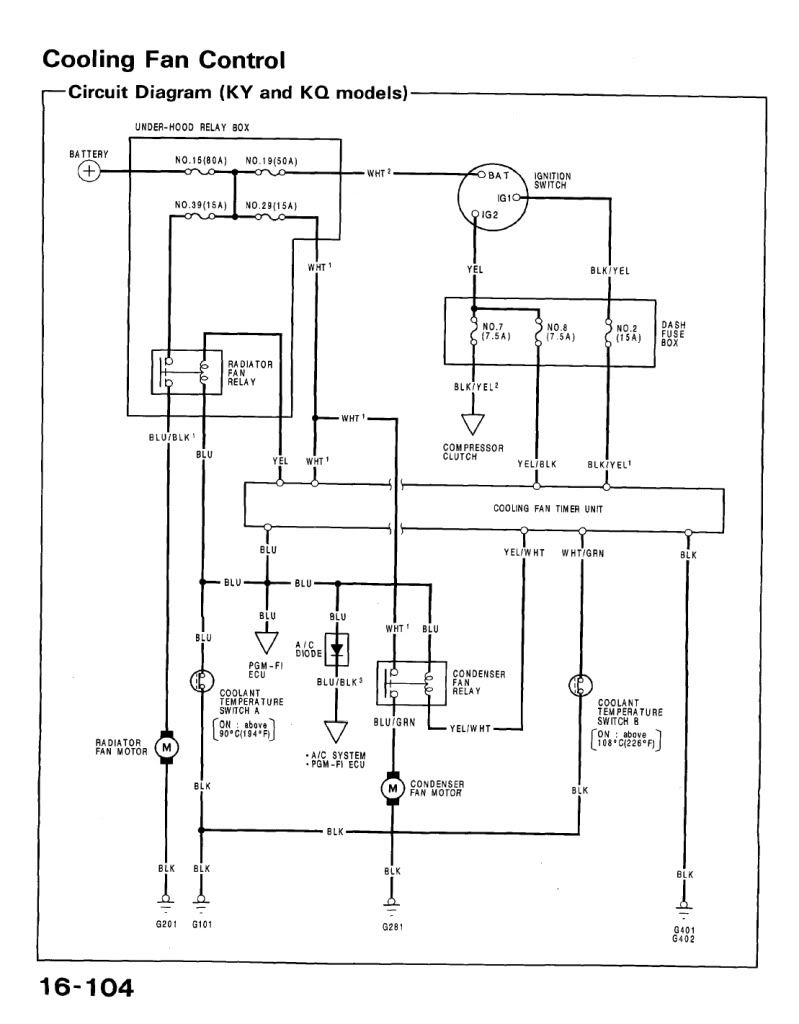
The fan with the plastic shroud is your Condensor Fan, it is associated with your A/C System. The fan with the metal shroud it the Radiator Fan, it is associated with your Cooling System.
You can pull the switches out and test them or can measure them in controlled situations while still in the car. I have some experience in this area, my V6 thread; I had a switch get stuck on my car. I think all they are is a wax filled brass cylinder with sprung switch, similar to how your radiator cap bleeds pressure off the cooling system. And if that is the case, the wax can bunch up while cooling and either damage the switch or misalign it with the internal contacts.
Anywho, that is all speculation. Pull out your handy dandy multimeter and lets see what you got.
Fuses:
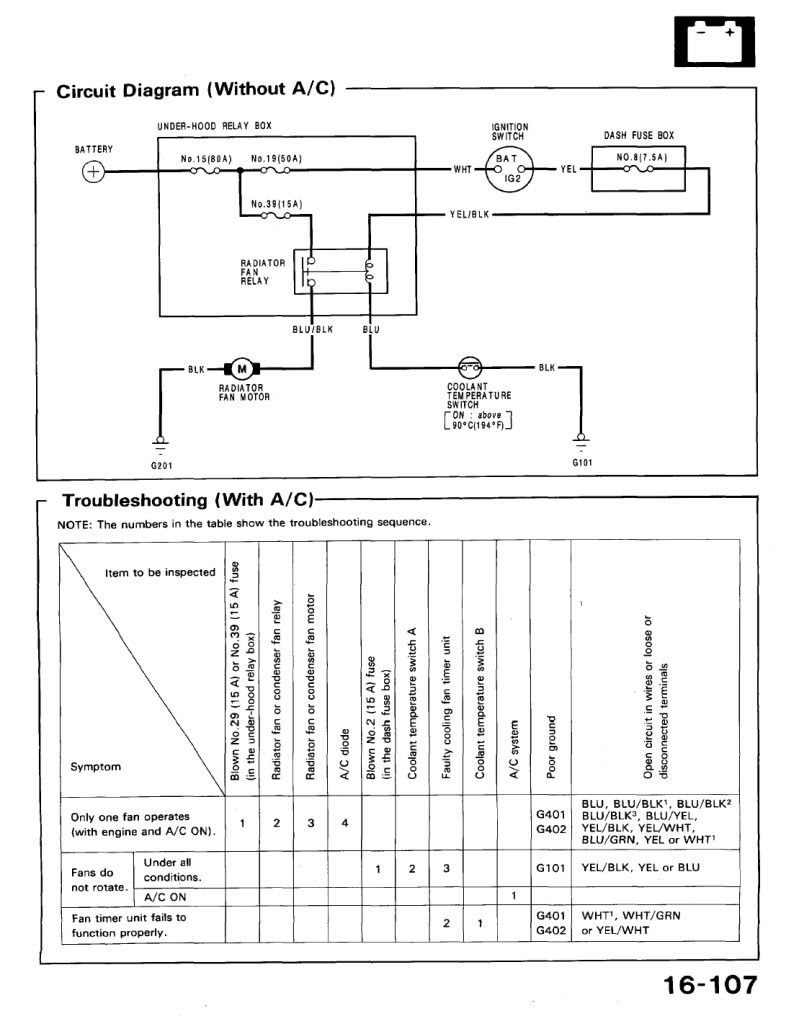
First be sure that you have not blown fuses. The ones you want to check are: Numbers 39 and 19 in the Under-Hood Fuse/Relay block, and Numbers 7, 8, and 2 in the In-Car Fuse/Relay Block.
Relays:
I see from your video that you know where to find the Radiator Fan Relay in the Under-Hood Fuse/Relay Block. That is good that you swapped with another relay, but I would like for you to use a jumper wire and close the switch side of that relay connection; this is to see if the connection between the relay and the fan is a good one. Another test would be to see if the relay is receiving voltage from the Cooling Fan Timer Unit, but this only occurs when the conditions are right (high cooling temp) and so is not the best test to perform. Besides, warm engine tests come later.
Motor:
You need to jump the Radiator Fan directly to Fuse 39 (15A). First verify the Radiator Fan has a good connection to ground, then use a probe and jumper wire to pull voltage right off the top of the fuse to the Radiator Fan's connector. The fan should turn on immediately.
Switch and Sensor Preface:
There are two switches, one is the primary switch, the other is a back-up that switches on at a higher temperature should something go wrong and the first does not switch the cooling fan on. The first switch you pointed to in your video is Switch B and the one behind your distributor is Switch A. Switch A closes at 194 °F and Switch B closes at 226 °F. There is also a Sensor sitting behind Switch B, it controls the temperature needle on your gauge cluster. You may want to check this as well.
Sensor:
While the engine is cold, i.e. let the car sit over night; check the resistance across the sensor:
- between -4°F and 32°F, you should see between 5 and 20 ohms
- between 32°F and 104°F, you should see between 1 and 5 ohms
Then run the car for about 10 minutes or until you see the temperature needle rise. Check the resistance across the sensor:
- between 104°F and 176°F, you should see less than 1 ohm, but more than a tenth of an ohm
- over 176°F, you should see the ohms drop off to zero or float real close to it
Switches:
While the car is warm, check to make sure that both switches are open, i.e. no resistance between their contacts. And if you haven't already done this, verify both switches have good connections with ground.
Let us know how it goes.
 1997 Honda Accord EX-V6:
C27A4 - 2.7-liter 90º-V6 with SOHC, 24-valves, PGM-Fi
MPZA - Electronically controlled 4-speed automatic, 1 reverse
~170 cu. in. / ~170 ft. lbs. / ~170 whp
Originally posted by James Matteu -
Glad to see that you're getting to the bottom of this problem, your other thread on this same problem.1997 Honda Accord EX-V6:
C27A4 - 2.7-liter 90º-V6 with SOHC, 24-valves, PGM-Fi
MPZA - Electronically controlled 4-speed automatic, 1 reverse
~170 cu. in. / ~170 ft. lbs. / ~170 whp
Originally posted by James MatteuComment

Comment