
-
-
pretty good ad....let's make a quarter-half a million car do a loop....!!! with also an Aston martin, ferrari and lambo.... VS
VS 
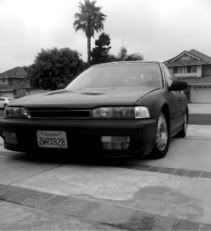
Mercyboy: I rather lose by a mile because I built my own car then win by an inch because someone else built it for me..your car is your story, so don't let someone else write the book!
MERCYBOY THREAD:http://www.cb7tuner.com/vbb/showthread.php?t=158241
1990 RHD Honda accord si CB3 Canada http://www.cb7tuner.com/vbb/showthread.php?t=196287
MY CB7 ON YOUTUBE: http://www.youtube.com/watch?v=CJID_IxwiNY -
I say it's possible. I've seen skateboarders do it in a pipe, why not a car in basically a bigger pipe? You can see the special curving ramps they constructed for it to get up and down on the flat walls.
Truly a sick video though.Comment
-
They got the stigs outfit wrong.
Comment
-
-
yep.Originally posted by visualpoet View Post
----------------My 92 Honda Accord LX---------------------- My 97 Nissan 240sx LE----
NE GUYS, Buy the last of my accord partsComment
-
I say it is possible if you have enough speed. Ever go to the circus and see the guys in the ball cage that ride their motorcycles upside down over and over again? I wouldn't see why this wouldn't work here. If you have enough speed and you steered hard enough, the momentum would carry you through.VIP Status.Comment
-
I think the correct term for it would be centripital force, or something like that.
----------------My 92 Honda Accord LX---------------------- My 97 Nissan 240sx LE----
NE GUYS, Buy the last of my accord partsComment
-
Comment
-
No, it's centrepital.
I'm too lazy to type all the info myself, so here you go:
Thanks interwebz!
centripetal force and centrifugal force
centripetal force and centrifugal force, action-reaction force pair associated with circular motion. According to Newton's first law of motion, a moving body travels along a straight path with constant speed (i.e., has constant velocity) unless it is acted on by an outside force. For circular motion to occur there must be a constant force acting on a body, pushing it toward the center of the circular path. This force is the centripetal (“center-seeking”) force. For a planet orbiting the sun, the force is gravitational; for an object twirled on a string, the force is mechanical; for an electron orbiting an atom, it is electrical. The magnitude F of the centripetal force is equal to the mass m of the body times its velocity squared v 2 divided by the radius r of its path: F=mv2/r. According to Newton's third law of motion, for every action there is an equal and opposite reaction. The centripetal force, the action, is balanced by a reaction force, the centrifugal (“center-fleeing”) force. The two forces are equal in magnitude and opposite in direction. The centrifugal force does not act on the body in motion; the only force acting on the body in motion is the centripetal force. The centrifugal force acts on the source of the centripetal force to displace it radially from the center of the path. Thus, in twirling a mass on a string, the centripetal force transmitted by the string pulls in on the mass to keep it in its circular path, while the centrifugal force transmitted by the string pulls outward on its point of attachment at the center of the path. The centrifugal force is often mistakenly thought to cause a body to fly out of its circular path when it is released; rather, it is the removal of the centripetal force that allows the body to travel in a straight line as required by Newton's first law. If there were in fact a force acting to force the body out of its circular path, its path when released would not be the straight tangential course that is always observed.
Read more: centripetal force and centrifugal force — Infoplease.com http://www.infoplease.com/ce6/sci/A0...#ixzz12emBI2hrLast edited by visualpoet; 10-17-2010, 06:20 PM.Comment


Comment