
Very cool thread I found at ClubRSX.com. Check out the link if you're interested on the debate on its validity over there...
http://forums.clubrsx.com/showthread.php?t=987138
I guess the S2000 has something like this from the factory.
http://forums.clubrsx.com/showthread.php?t=987138
Originally posted by Phr34k
note: i do not take any responsibility for what you do to your car. the formula included should help reduce drone, but i do not guarantee it. i got this information from a friend and muscle car forums.
hi! as many of us have aftermarket exhaust systems, i'm sure that exhaust drone is a common problem. i haven't seen another thread on CRSX showing how to eliminate drone, so hopefully this information will be useful for both current and future car enthusiasts. the thing i am referring to is called a "Helmholtz resonator," which is basically a dead-end pipe branching out from the exhaust pipe that bounces sound around to cancel itself out. i was able to completely get rid of a really bad drone that i had around 3-4k RPM, and since sharing is caring, here you go!
the concept of this resonator is quite complicated when trying to understand how sound and frequency works, but the steps involved are fairly simple. here's how:
1. you will need two variables: the drone RPM, and # of cylinders your engine has.
2. divide the RPM by 60 to get the RPS, or revolutions per second.
3. divide the # of cylinders by 2 to get # fired per revolution.
4. multiply RPS by # fired per rev to get the drone frequency in Hz.
5. divide the speed of sound by the Hz. the speed of sound is a constant 1,260 ft/s. the number is funky because sound travels faster in warm air, and the air coming from an exhaust is very hot.
6. take the result from #5 and divide by 4.
7. take the result from #6 and multiply by 12 to get the resonator length in inches needed to cancel the drone at that RPM.
here's my car's calculations as an example:
1. my car drones the worst at 3,300 RPM and has 4 cylinders.
2. 3,300 / 60 = 55.0 RPS
3. 4 / 2 = 2
4. 55.0 * 2 = 110 Hz
5. 1,260 / 110 = 11.45
6. 11.45 / 4 = 2.86
7. 2.86 * 12 = 34.36 inches
from the result shown, my car needs a resonator of approximately 34.4 inches to add a damper that is tuned for my drone.
the piping should ideally be the same diameter as that of your exhaust pipe. it needs to branch out from the exhaust itself and lead to a dead end so no air can escape (otherwise you'd have quite a nasty exhaust leak). the dead end can be a piece of metal welded onto the tip, or you can even run it back to the outside of the exhaust. this pipe will not hinder performance, as no air will be able to enter it. i have not gotten a chance to take a picture of my resonator, but here's a link to an old thread i made and some pictures i found on Google:
http://forums.clubrsx.com/showthread...9304&highlight <- my old thread filled with wrong calculations
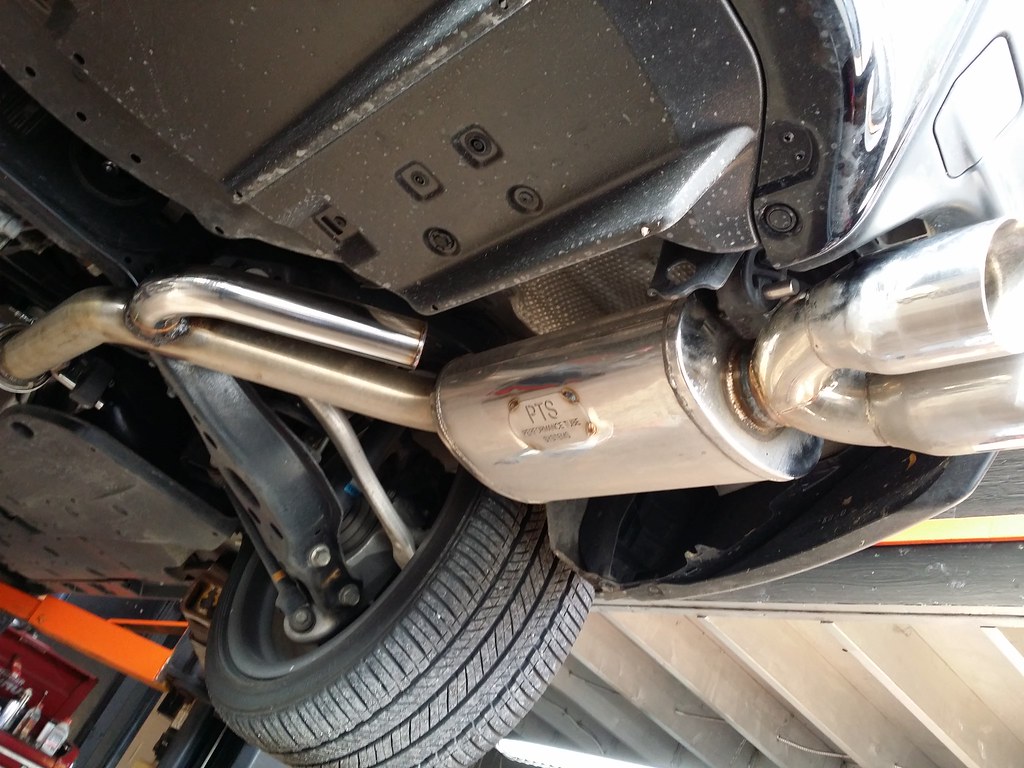

^ not my car, but here's what the resonator can look like
i was told the placement of the resonator matters in terms of efficiency, but i have seen people put them all over the place so i can't really comment on it. mine sits around the middle of the car between the front and rear seats.
i hope this info proves useful to someone. it has certainly made driving much more enjoyable for me. let me know if you have any questions or if i made a mistake somewhere. it's been a long time since i did this, so my memory is a little fuzzy :noes:
hi! as many of us have aftermarket exhaust systems, i'm sure that exhaust drone is a common problem. i haven't seen another thread on CRSX showing how to eliminate drone, so hopefully this information will be useful for both current and future car enthusiasts. the thing i am referring to is called a "Helmholtz resonator," which is basically a dead-end pipe branching out from the exhaust pipe that bounces sound around to cancel itself out. i was able to completely get rid of a really bad drone that i had around 3-4k RPM, and since sharing is caring, here you go!
the concept of this resonator is quite complicated when trying to understand how sound and frequency works, but the steps involved are fairly simple. here's how:
1. you will need two variables: the drone RPM, and # of cylinders your engine has.
2. divide the RPM by 60 to get the RPS, or revolutions per second.
3. divide the # of cylinders by 2 to get # fired per revolution.
4. multiply RPS by # fired per rev to get the drone frequency in Hz.
5. divide the speed of sound by the Hz. the speed of sound is a constant 1,260 ft/s. the number is funky because sound travels faster in warm air, and the air coming from an exhaust is very hot.
6. take the result from #5 and divide by 4.
7. take the result from #6 and multiply by 12 to get the resonator length in inches needed to cancel the drone at that RPM.
here's my car's calculations as an example:
1. my car drones the worst at 3,300 RPM and has 4 cylinders.
2. 3,300 / 60 = 55.0 RPS
3. 4 / 2 = 2
4. 55.0 * 2 = 110 Hz
5. 1,260 / 110 = 11.45
6. 11.45 / 4 = 2.86
7. 2.86 * 12 = 34.36 inches
from the result shown, my car needs a resonator of approximately 34.4 inches to add a damper that is tuned for my drone.
the piping should ideally be the same diameter as that of your exhaust pipe. it needs to branch out from the exhaust itself and lead to a dead end so no air can escape (otherwise you'd have quite a nasty exhaust leak). the dead end can be a piece of metal welded onto the tip, or you can even run it back to the outside of the exhaust. this pipe will not hinder performance, as no air will be able to enter it. i have not gotten a chance to take a picture of my resonator, but here's a link to an old thread i made and some pictures i found on Google:
http://forums.clubrsx.com/showthread...9304&highlight <- my old thread filled with wrong calculations
^ not my car, but here's what the resonator can look like
i was told the placement of the resonator matters in terms of efficiency, but i have seen people put them all over the place so i can't really comment on it. mine sits around the middle of the car between the front and rear seats.
i hope this info proves useful to someone. it has certainly made driving much more enjoyable for me. let me know if you have any questions or if i made a mistake somewhere. it's been a long time since i did this, so my memory is a little fuzzy :noes:







Comment