Announcement

Collapse
No announcement yet.

Waterless Coolant

Collapse
X
 
  • Filter
  • Time
  • Show
Clear All
new posts

    Waterless Coolant

    I don't know if anyone else has heard of this stuff - I only just discovered it on the new TR6 episode of Wheeler Dealers - but it sounds like a brilliant idea. It won't slowly eat away at the inside of your engine, and best of all you'll never have to change the stuff... ever. Supposedly helps fuel economy as well, and that is definitely never a bad thing. Thought I'd share this link; my new engine will see nothing but.

    http://www.jaylenosgarage.com/extras...nt/index.shtml
    Accord Aero-R

    #2
    I'm thinking bout trying it in my rebuild since I'm starting with a fresh block and I can skip the water flushing part. I would like to get rid of the overflow tank too.


    Formerly 91AccordExR33
    11.68 @ 127mph
    417whp/375wtq
    Sold: 8/2016

    Comment


      #3
      This stuff is quite fascinating.


      Comment


        #4
        Hmm. Very interesting.

        I looked up the conversion centers on there website and the first one on the list is like 20 miles from me hahaha
        Last edited by Bullhorn7; 01-17-2013, 12:33 PM.
        -Will

        Comment


          #5
          It sounds like it would be simple enough to do yourself. The only involved step of the process seems to be to completely remove any water from the cooling system. They say the mixture can tolerate up to 3% water, meaning you don't have to get it all, which is good for certain engine designs where that would be near impossible, but I don't think that's a big deal for the F22.

          I wonder if you could flush with pure ethylene glycol (no water), and then mix those remnants with the Evans. It might be cheaper at that point, if it's an issue, to go to a conversion shop as mentioned.

          Re: fuel economy.

          Their claims for fuel economy seem to be hinged upon the higher operating temperature the mixture affords. Because our engines are electronically temperature controlled, it doesn't sound like we should be expecting any improvements here. Does anyone have any insight on what it would take to convert the system to run at a higher operating temperature? What are the main drawbacks in doing so? I'm sure one could change the thermostat and cooling fan trip points, but wouldn't the ECU program have to be changed/tuned as well in order to take advantage of this and keep things running nice?
          Last edited by reklipz; 01-17-2013, 12:52 PM.

          Comment


            #6
            This makes me think liquid nitrogen in lieu of regular coolant. After all PC's can run on this as well. Deff sparking new ideas here and overheating would be non-existent!!!!
            The CB7 Collector.
            Team Kindred Impulse Member #3
            92 LX Coupe F22A1
            2013 Toyota Corolla S
            92 EX Sedan F22A1
            Originally posted by deevergote
            Do you really need to make a thread asking if having your car like this /---\ will cause uneven tire wear? Try walking like that for a few weeks and see if your shoes wear funny! (hint: they will.)

            Comment


              #7
              Originally posted by reklipz View Post
              Re: fuel economy.

              Their claims for fuel economy seem to be hinged upon the higher operating temperature the mixture affords. Because our engines are electronically temperature controlled, it doesn't sound like we should be expecting any improvements here. Does anyone have any insight on what it would take to convert the system to run at a higher operating temperature? What are the main drawbacks in doing so? I'm sure one could change the thermostat and cooling fan trip points, but wouldn't the ECU program have to be changed/tuned as well in order to take advantage of this and keep things running nice?
              Below is my take on your question. I could be wrong.
              I really don't think ECU has much interest in knowing exact engine temp and controlling it. It cares if the engine temp is higher than specified temp or not.
              Water temp is cooled down by electric fan, which comes on when coolant temp reaches certain temp (spec is in the manual).
              Engine/coolant temp is set by the thermostat.
              Throw in higher temp thermostat and you should get higher engine temp. Cooling fan may cycle many times more than before to contain the coolant temp.
              Last edited by oyajicool; 01-17-2013, 06:24 PM.
              A&P-IA

              Comment


                #8
                Originally posted by oyajicool View Post
                Below is my take on your question. I could be wrong.
                I really don't think ECU has much interest in knowing exact engine temp and controlling it. It cares if the engine temp is higher than specified temp or not.
                Water temp is cooled down by electric fan, which comes on when coolant temp reaches certain temp (spec is in the manual).
                Engine/coolant temp is set by the thermostat.
                Throw in higher temp thermostat and you should get higher engine temp. Cooling fan may cycle many times more than before to contain the coolant temp.
                oyajicool, thanks for the reply! I'll go through my thoughts again, this time a little more clearly.

                What does it take to increase the operating temp on our engines? Here's what I can come up with.
                1. Change the thermostat to one that operates at the desired operating temperature. Simple.
                2. Change the radiator fan temperature switch ("Switch A" for those with the A/C option) so that it operates in proper relation with the desired operating temperature. Simple in principle, but perhaps a bit more difficult in practice.
                3. If the desired operating temperature is close to the operating point of "Switch B" (for those with the A/C option), it would be desirable to change this switch so that it operates at an appropriate margin.
                4. There is a sensor for the coolant temperature gauge on the dash of the vehicle. This is a non-issue, assuming the driver is informed of the change in operating temperature.
                5. There is a sensor for the ECM to detect the coolant temperature as well, apparently.


                The biggest concern is the last item, item 5 by my count.

                I assume the engine coolant temperature is used in some of the engine instruction system/calculation in the ECM. Further, I assume the ECM maps and program are "tuned" with a specific operating temperature in mind. These would have to be changed to take full advantage of the new operating temperature, would they not? What would be potential issues if this item was not accounted for?
                Last edited by reklipz; 01-17-2013, 07:04 PM.

                Comment


                  #9
                  the engine can control its temperature electronically
                  a rich mixture burns cooler than a lean mixture, a lean mixture will heat up the cylinder wall higher than a rich mixture

                  also a thermostat controls the minimum engines temp only


                  i'll stick with regular ethylene glycol, i change it way before than the recommened interval

                  i dont believe on anything that never needs to be changed

                  $15 a gallon, change it every year, i can live with that
                  Originally posted by deevergote
                  Just do what PR CB7 said.

                  "I'm Going For Wood" (Clickey Clickey)

                  Comment


                    #10
                    I took a quick look at their web site. I didn't see much information on low temperature capability (heavy duty was down to -40 F) or a comparison of its specific heat and thermal conductivity relative to water or water/ethylene glycol mixtures. I sent them a few questions; will post the answers when they respond.
                    90 LX 4dr 5 spd 396,014 (sold 1/1/2022) - MRT: http://www.cb7tuner.com/vbb/showthread.php?t=201450
                    08 Element LX FWD AT 229,000 - MRT: fleetw00d : 2008 Honda Element LX - CB7Tuner Forums

                    Comment


                      #11
                      Originally posted by reklipz View Post
                      oyajicool, thanks for the reply! I'll go through my thoughts again, this time a little more clearly.

                      What does it take to increase the operating temp on our engines? Here's what I can come up with.
                      1. Change the thermostat to one that operates at the desired operating temperature. Simple.
                      2. Change the radiator fan temperature switch ("Switch A" for those with the A/C option) so that it operates in proper relation with the desired operating temperature. Simple in principle, but perhaps a bit more difficult in practice.
                      3. If the desired operating temperature is close to the operating point of "Switch B" (for those with the A/C option), it would be desirable to change this switch so that it operates at an appropriate margin.
                      4. There is a sensor for the coolant temperature gauge on the dash of the vehicle. This is a non-issue, assuming the driver is informed of the change in operating temperature.
                      5. There is a sensor for the ECM to detect the coolant temperature as well, apparently.


                      The biggest concern is the last item, item 5 by my count.

                      I assume the engine coolant temperature is used in some of the engine instruction system/calculation in the ECM. Further, I assume the ECM maps and program are "tuned" with a specific operating temperature in mind. These would have to be changed to take full advantage of the new operating temperature, would they not? What would be potential issues if this item was not accounted for?
                      I think you are thinking way too much. You may want to double check Honda service manual and wiring diagram for cooling system. Again, I could be wrong but what you are saying is not flying with me.

                      also a thermostat controls the minimum engines temp only
                      I am not understanding what is said here. Can you please explain this in detail so an old man like me can understand?

                      the engine can control its temperature electronically
                      a rich mixture burns cooler than a lean mixture, a lean mixture will heat up the cylinder wall higher than a rich mixture
                      I thought the O2 sensor is the one that contribute in determining Air-Fuel Ratio for our engine. I haven't had my LX's engine overheat on me so I cannot say for sure. But I have not yet to see any car which is just about to overheat belching black smoke due to the ECU on that car is enriching AFR in an attempt to cool down the operating temp.

                      I was driving an overheating '97 Mazda on I-95 many years ago. The car was slowing down and I had to move to the shoulder. Looking back in rear view mirror paying attention to oncoming cars, I didn't see any black smoke coming out of my car, as far as I can remember.

                      Maybe I am thinking way too much as well.
                      A&P-IA

                      Comment


                        #12
                        Originally posted by PR CB7 View Post
                        the engine can control its temperature electronically
                        a rich mixture burns cooler than a lean mixture, a lean mixture will heat up the cylinder wall higher than a rich mixture
                        I agree, the engine can actively choose a leaner mixture to heat itself up. But, do our ECMs do this? I doubt it, from what I understand. I have been known to be wrong, though.

                        Originally posted by PR CB7 View Post
                        also a thermostat controls the minimum engines temp only
                        A valid point, though from my understanding it is better to have the thermostat more or less "centered" around your desired operating point.

                        Originally posted by oyajicool View Post
                        I think you are thinking way too much. You may want to double check Honda service manual and wiring diagram for cooling system. Again, I could be wrong but what you are saying is not flying with me.
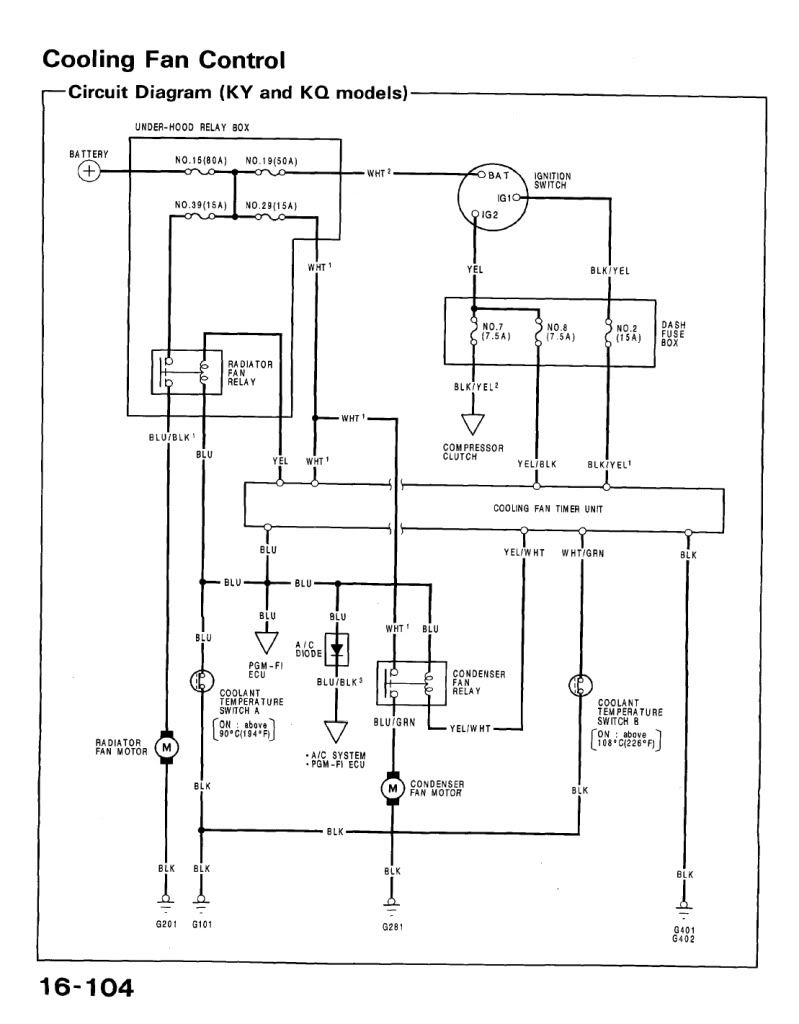
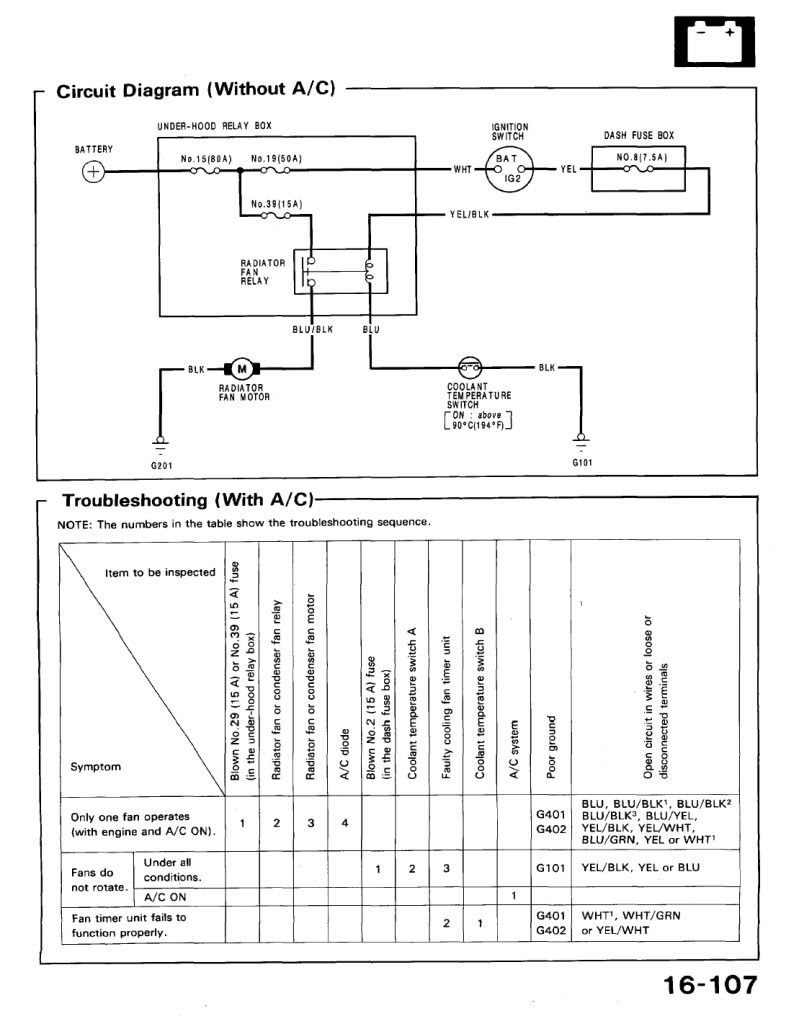
                        These two diagram show that Switch A (which activates at the operating temperature, 194 °F, if I'm not mistaken), actively controls the radiator fan. There is also a signal to the ECU and the Fan Control module if the switch closes. In order to keep this fan from constantly trying to cool the radiator, the switch would need to be changed to a different one.


                        The other fan switch, only on systems with A/C (which is most, I believe), may need to change as well, if you bump the operating temperature up close enough to its switch point. If you change it, you should probably try to maintain the relative difference between its switch point and the operating temp (about 32 °F, it looks like).

                        This is probably a tricky swap to do, because finding switches that work at these temperatures is probably not an easy task, let alone finding one that has the same threading, dimensions, and connector. But a little bit of ingenuity can fix that no problem.

                        Originally posted by fleetw00d View Post
                        I took a quick look at their web site. I didn't see much information on low temperature capability (heavy duty was down to -40 F) or a comparison of its specific heat and thermal conductivity relative to water or water/ethylene glycol mixtures. I sent them a few questions; will post the answers when they respond.
                        Awesome; thanks fleet.


                        Originally posted by PR CB7 View Post
                        i'll stick with regular ethylene glycol, i change it way before than the recommened interval

                        i dont believe on anything that never needs to be changed

                        $15 a gallon, change it every year, i can live with that
                        That just seems silly to me. For one, it sounds like converting to this would be even more of a costs savings in your case. Two, your worries about "not believing in anything that never needs to be changed" are illogical; science is a powerful thing. Of course, do as you please, I'm not going to try to convince someone who doesn't want convincing.

                        Comment


                          #13
                          Originally posted by oyajicool View Post
                          I really don't think ECU has much interest in knowing exact engine temp and controlling it. It cares if the engine temp is higher than specified temp or not.
                          I really don't think the ECU on our car has enough brain power or means to control engine temp. I'll have a second look see on the manual when I have time.
                          A&P-IA

                          Comment


                            #14
                            Originally posted by oyajicool View Post
                            I really don't think the ECU on our car has enough brain power or means to control engine temp. I'll have a second look see on the manual when I have time.
                            I agree, I doubt the ECM actually controls the temp. What matters though is what it does with its knowledge. One post I've seen claims that there is a separate temperature sensor for the ECM, and that the ECM can turn the radiator and condenser fans on. I initially thought this was more of a signal to the ECM that the condenser fan was turned on, because it is not shown on models without the A/C system, but I am unsure.

                            If the ECM has its own sensor for temperature, then that means that the operating temperature is hard coded into the ECM program, meaning changing the temperature is not so straight forward. If we increase the temp by changing the thermostat and fixing the fan switches, the ECM will always think the engine is running hot (which from its perspective, it is). Now, if the ECM doesn't actually do anything with that information, then it doesn't matter, but that doesn't seem like something Honda would do.
                            Last edited by reklipz; 01-17-2013, 10:57 PM.

                            Comment


                              #15
                              Originally posted by reklipz View Post
                              One post I've seen claims that there is a separate temperature sensor for the ECM, and that the ECM can turn the radiator and condenser fans on.
                              I suggested to double check the wiring diagram. Do you see such circuitry and sensor in the diagram you posted? Does the service manual describe such system?
                              Last edited by oyajicool; 01-18-2013, 06:21 AM.
                              A&P-IA

                              Comment

                              Working...
                              X